


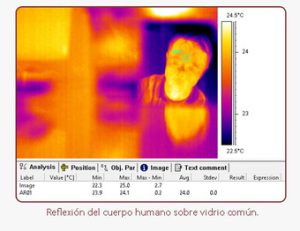
There is much confusion regarding the concept of reflectivity. It is common to assume that surfaces with specular reflection have high reflectivity, and therefore, those that do not behave like a mirror have low reflectivity.
The objective of this work is to practically demonstrate that surfaces with low reflectivity but specular mirror behavior are very common, and to compare this with the behavior of highly reflective specular surfaces.
Furthermore, it is shown that it is possible to measure temperatures on specular surfaces, even if false hot spots appear. Finally, a method is proposed to determine the emissivity of specular surfaces with low emissivity, even for values below 1.
Let’s recall one of our best courses: the Level 1 infrared thermography course. A significant part of this course deals with the outgoing radiation from an opaque surface, which generally consists of two terms: emission and reflection.
We associate the dimensionless parameter reflectivity with this second term, which is complementarily related to emissivity (1-ε), and an apparent reflected temperature, which is measured in a rather strange way for beginners, with a crumpled piece of aluminum. However, because it is certified according to an ISO standard—which I don’t quite remember, yes, ISO 18434-1—it suddenly becomes very rigorous. Regarding the reflected component, it is stated during the course that it does not heat the surface on which it is reflected; it can even heat surrounding objects and many other very interesting things. Seriously, I recommend the course; it’s not just because I teach it.
This article attempts to shed some light on this complicated topic, but it’s always possible that I may not explain myself clearly, and you might end up more confused than before!
You can download the full article by clicking here.
About Rafael Royo
Rafael Royo Pastor is a Doctor of Industrial Engineering and works as a Professor at the Institute of Energy Engineering – Polytechnic University of Valencia (UPV) – Spain. He is Level III certified, specializing in infrared radiation and heat transfer, having focused on three application fields: automotive internal combustion engines, energy optimization and efficiency, and high-efficiency buildings.
He has collaborated with the Renault Spain Studies Department for almost ten years, and with companies such as ACCIONA.
Finally, Rafael is an active collaborator with the ITC in the development of training materials, leading the team of instructors in Spain, and delivering courses in both Spain and Latin America.
