

The Next Gen car, formerly known as the Gen-7 car, is the common name for the new race car that will be used in the NASCAR Cup Series starting in 2022. The NASCAR Next Gen project marks a new era for the highest level of stock car racing. Brandon Thomas, General Manager, and a team of engineers set out to develop the seventh-generation race car that would enter competition starting in 2022. Beyond numerous performance improvements, this new design will help reduce the significant operational cost of racing. The Next Gen model offers a new level of modularity, allowing teams to replace smaller components instead of entire vehicle segments.
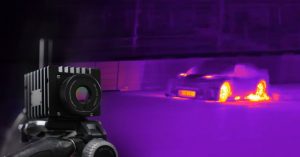
As expected with a complete redesign, initial vehicle testing revealed several opportunities for improvement. Additionally, several drivers reported excessive heat in the cockpit, which was a cause for concern as it threatened driver comfort and concentration. The primary source of this increased heat was not immediately apparent, leading NASCAR to invite Teledyne FLIR for a proof-of-concept test in Richmond, VA, with the goal of identifying the origin of the problem.
FLIR mounted two A50 thermal cameras in the car’s cockpit: one aimed at the driver’s feet, and another on the roll cage to provide a wide-angle view. The new A50 cameras are designed for fixed-mount condition monitoring and visualize temperature changes to detect equipment malfunction or overheating. This allowed NASCAR to monitor temperature fluctuations and identify the hottest areas of the car during longer races.
Before testing, initial theories about the heat problem pointed to the new dual exhaust system. With hot gases flowing beneath the driver and escaping to the right and left of the vehicle, all eyes were on the camera mounted in the pedal area. However, it was the secondary wide-angle thermal camera that shed some light: longer runs revealed that excessive heat was penetrating the firewall panel between the engine and the passenger compartment. Team members installed additional heat shields in the problematic areas, and A50 images helped confirm that these changes improved cockpit conditions.
