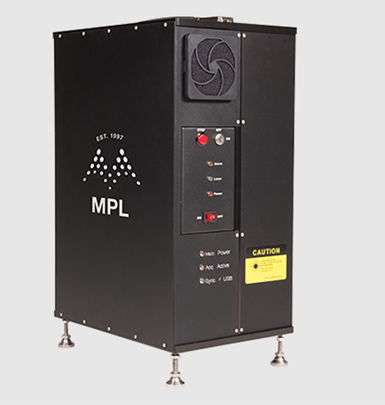

Description
Vertical characterization of aerosols and clouds is essential for understanding atmospheric processes, assessing air quality and validating climate models. Lidar systems allow real-time profiles of backscatter, cloud altitude and boundary layer evolution to be obtained without the need for direct contact with the environment.
At Álava Ingenieros, we work with Droplet Measurement Technologies, a leader in optical instrumentation for atmospheric studies, to offer the Micro Pulse Lidar (MPL) range, internationally recognized for its reliability, low power consumption and continuous operation capability. These systems use low energy laser pulses and single photon detection to generate high resolution vertical profiles.
Droplet MPLs are ideal for environmental monitoring networks, scientific campaigns, satellite validation and pollutant dispersion studies. Their compact design, ease of integration and resistance to extreme conditions make them key tools for meteorological research, climate monitoring and air quality control.
MPL for aerosol monitoring
Vertical profiling of aerosols for air quality and pollutant dispersion studies.
Droplet MPLs allow the detection and characterization of aerosol layers in real time, with high vertical resolution. They are ideal for assessing particle transport, Saharan dust intrusions, fire smoke and urban pollution. Their autonomous and continuous operation makes them suitable for scientific networks and fixed stations.
Enriched content:
- Elastic backscatter detection up to 15 km.
- Vertical resolution from 30 m.
- Compatible with dispersion models and air quality networks.
- Applications: pollution, atmospheric dust, forest fires.
MPL for cloud and boundary layer studies
Measurement of cloud altitude and planetary boundary layer (PBL) evolution.
Droplet offers MPL systems to characterize clouds and the atmospheric boundary layer, essential in meteorological and climate studies. They allow the detection of cloud bases, diurnal evolution of the PBL and validation of satellite sensors. Their optical precision and operational stability make them a reference for ground and aerial observation.
Enriched content:
- Cloud detection with subminutal time resolution.
- Automatic algorithms for PBL identification.
- Integration with weather stations and mobile platforms.
- Applications: meteorology, climatology, satellite validation.
Portable MPL for scientific campaigns
Compact lidar system for field deployment, mobile platforms and comparative studies.
Droplet Measurement Technologies’ MiniMPL offers lidar capabilities in a portable format, ideal for scientific campaigns, comparative studies and remote area deployments. Its low power consumption, rugged design and ease of transport allow for high quality measurements in real-world conditions, with minimal infrastructure.
Enriched content:
- Low weight and battery or mains power supply.
- Continuous recording with geolocation.
- Web interface for remote control.
- Applications: mobile campaigns, field validation, comparative studies.
Reference MPL for scientific networks
Reference instrument for atmospheric observation networks and climate model validation.
Droplet Measurement Technologies offers MPL as a reference system for scientific networks such as NASA MPLNET. Its stability, traceability and compatibility with international protocols make it a key tool for model validation, long-term studies and atmospheric data certification.
Enriched content:
- Single photon detection with high sensitivity.
- Traceable calibration and minimum annual drift.
- Compatible with international networks and data exchange protocols.
- Applications: climatology, satellite validation, global observation.