

A portable NIR analyzer to detect adulterations in cocoa will allow us to:
- Determine and quantify quality parameters in raw materials.
- Take measurements even through plastic packaging.
- Portable device for use in the warehouse or outdoors.
- Easy to use thanks to its intuitive interface and touchscreen.
Visum Palm: On-Site Quality Control to Detect Adulterations
The globalization of food distribution creates many opportunities for fraud, which includes economic and food safety issues. Therefore, detecting adulterations in raw materials is crucial for companies.
Cocoa powder has been included as one of the 25 most adulterated ingredients according to a food fraud database. Furthermore, the most recent cocoa fraud cases in Europe report discrepancies compared to the values stated on labels.
Cocoa products can be adulterated with a wide range of products, including arrowroot, flour, chicory, peanut shells, soy flour, among others.
Classical methods for cocoa powder analysis, such as liquid chromatography, are complicated and require significant time investment. Near-infrared spectroscopy (NIR) offers the advantage of obtaining results more quickly and easily through non-destructive analysis. Additionally, this same technology can be used for quality control of other products such as oil or snacks.
Case Study:
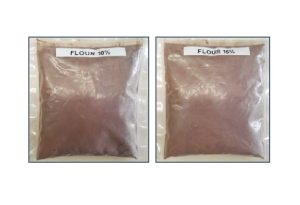
Using the portable analyzer VISUM Palm, the spectrum of a large number of cocoa powder samples adulterated with wheat flour in different proportions (from 0 to 100%) was acquired through the plastic bags containing them.
The differences in the “spectral fingerprints” between both products are very clear. NIR allows these differences to be seen, which are undetectable to the human eye.
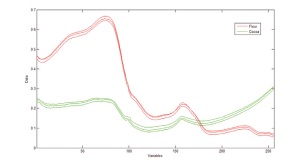
Differences Between the Spectrum of Flour and Cocoa
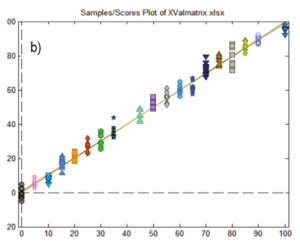
With the acquired spectral data, a chemometric model was developed to determine the weight percentage of flour present in each bag. The model was integrated into VISUM Palm, enabling the device to detect and quantify, in a matter of seconds, the percentage of adulterant (flour) present in the cocoa powder with an accuracy of 3.5%.
Conclusions
VISUM PALM is capable of detecting adulterations in cocoa powder with flour through plastic bags with an accuracy of 3.5% in less than 5 seconds. Furthermore, NIR technology allows establishing a “chemical fingerprint” of the pure product, enabling future adulterations to be detected.
