Share:

Near field systems


A near-field measurement system is usually implemented indoors (anechoic chamber) and occupies relatively little space compared to a far-field or compact system.

Description

A near-field near-field measurement is usually implemented indoors (anechoic chamber) and occupying relatively little space compared to a far-field or compact far-field or compact.

The basic operation consists of a measurement probe that is positioned at points close to the surface of the antenna under study, obtaining a matrix of amplitude and phase measurements on surfaces around the antenna (near field) which allows later, by means of processing techniques, to know also how it will behave in the far field (near field). far field as well as other typical parameters.

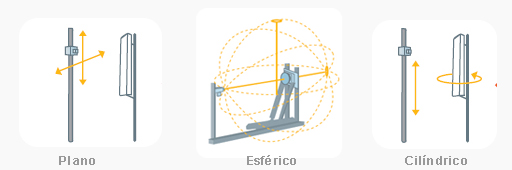
The most common configurations of this type of systems are:

  • Flat Scanner: An X-Y positioner is responsible for taking measurements on the aperture surface of the antenna under test.
  • Spherical: The antenna under test is placed on a spherical positioner, while a (fixed) measurement probe obtains measurement data resulting from moving the antenna under test in three orthogonal angular axes.
  • Cylindrical: The antenna under test is placed on an axis that rotates angularly while a measuring probe whose displacement is linear takes the corresponding measurement values.
Other products you may be interested in

  • A compact field measurement system tries to achieve a flat wavefront in a smaller space than in a conventional far field.
    Compact field systems


    A compact field measurement system tries to achieve a flat wavefront in a smaller space than in a conventional far field.
  • The purpose of far-field systems is to be able to characterize radiating devices, measuring at a sufficient distance so that the wavefront produced by the device can be considered flat.
    Far-field systems


    The purpose of far-field systems is to be able to characterize radiating devices, measuring at a sufficient distance so that the wavefront produced by the device can be considered flat.
  • These are usually covered by radoms that have to protect them for their correct operation without interfering with data transmission and reception.
    Rádomos measurement systems


    These are usually covered by radoms that have to protect them for their correct operation without interfering with data transmission and reception.
  • A radar cross section (RCS) measurement system has as its object of study the observation of signal reflections emitted by a radar on objects in any position.
    Radar Cross Section Systems (RCS)


    A radar cross section (RCS) measurement system has as its object of study the observation of signal reflections emitted by a radar on objects in any position.