

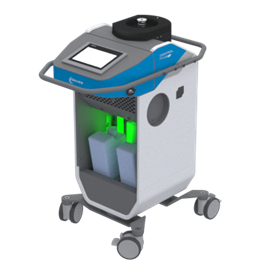

Description
Peroxide biodecontamination is a process used to eliminate microorganisms (bacteria, viruses, fungi, spores) from surfaces, equipment or closed environments by using hydrogen peroxide (H₂O₂) in vapor or aerosol form.
How does it work?
1. Generation of the decontaminant
Hydrogen peroxide is used in liquid form that is transformed into vapor (VHP: Vaporized Hydrogen Peroxide) or microdroplets (dry spray).
2. Biocidal action
H₂O₂ is a very powerful oxidant. When it comes in contact with microorganisms, it destroys essential components such as:
- Cell membranes
- Proteins
- Nucleic acids
This causes the death of the microorganism.
3. Typical cycle phases
- Conditioning: Ambient humidity and temperature are adjusted.
- Injection: Peroxide vapor or aerosol is introduced.
- Exposure: Concentration is maintained for a specified time to ensure inactivation.
- Aeration: Residual peroxide is removed, returning the environment to safe conditions.
Advantages:
- High efficacy against spores and resistant microorganisms.
- It does not leave toxic residues (it decomposes in water and oxygen).
- It can be applied in clean rooms, medical equipment, laboratories, pharmaceutical industry.
Applications:
- Hospitals: Disinfection of operating rooms, isolation rooms.
- Pharmaceutical industry: Sterilization of critical areas.
- Laboratories: Decontamination of biosafety cabinets.
Other products you may be interested in
More information about Peroxide disinfection
Most commonly used methods
- Vaporization of Hydrogen Peroxide (VHP)
- Description: H₂O₂ vapor is generated from a liquid solution and introduced into the closed environment.
- Advantages:
- High penetration in surfaces and equipment.
- It does not leave toxic residues (it decomposes in water and oxygen).
- Applications: Clean rooms, isolators, production equipment.
- Considerations: Strict temperature and humidity control to avoid condensation.
- Fogging (dry or wet spray)
- Description: H₂O₂ is dispersed as microdroplets (aerosol) by nebulization systems.
- Advantages:
- Homogeneous coverage.
- Lower product consumption than vaporization.
- Applications: Hospital areas, operating rooms, biosafety cabins.
- Considerations: Longer exposure time than VHP.
- Hydrogen Peroxide Plasma
- Description: H₂O₂ in vapor phase is used and subjected to an electric field to generate plasma.
- Advantages:
- High efficacy against resistant microorganisms.
- Fast process.
- Applications: Sterilization of medical instruments and devices.
- Considerations: Requires specialized equipment.
- Hydrogen Peroxide Liquid (Direct Spray)
- Description: Direct application of liquid solution on surfaces.
- Advantages:
- Simple and economical method.
- Applications: Cleaning of small surfaces, non-sensitive equipment.
- Considerations: Reduced range, risk of corrosion in some materials.
Critical factors for effectiveness
- Concentration: Normally between 30% and 35% for VHP, and 6%-12% for nebulization.
- Exposure time: Depends on method and bioburden.
- Temperature and humidity: Controlled to avoid condensation and ensure diffusion.
- Validation: Use of biological indicators ( Geobacillus stearothermophilus spores).
