
Description
It is widely used in the food industry, pharmaceutical sector, drinking water, hospitals, environment, and any field where the presence of microbes impacts safety or quality.
The main objectives are to evaluate the microbiological quality of a product or environment.
- Verify regulatory compliance (ISO, GMP, WHO, health regulations…).
- Detect contamination in production stages.
- Monitor the effectiveness of cleaning and disinfection processes.
- Investigate incidents (outbreaks, deviations, hygiene failures).
In pharma, microbiological sampling is a critical activity to ensure that drugs – especially sterile drugs – are manufactured under controlled conditions, free of microorganisms that could compromise patient safety.
Main objectives in pharma
To ensure the microbiological quality of the product during all phases of the process.
2. Confirm compliance with GMP, Annex 1 (EudraLex) and FDA aseptic processing guidance.
3. Monitor the environmental condition of clean rooms, booths, laminar flows and sterile areas.
4. Monitor personnel hygiene, the major source of contamination.
5. Prevent deviations, recalls and risks to the patient.
Type of microbiological sampling
1. Environments
In classified clean rooms (ISO 5 to ISO 8 / Grades A-D):
– Active impaction air (SAS, MAS, PAB).
– Air by passive sedimentation (settle plates).
– Viable and in some cases non-viable particles.
2. Surfaces
– Swabs
– Contact plates (RODAC)
– Sampling after cleaning/disinfection
3. Staff
Before, during or after critical operations:
– Fingerprints (finger plates)
– Sterile clothing: gloves, sleeves, apron
4. Pharmaceutical water
According to type:
– PW (Purified Water)
– WFI (Water for Injection)
– Condensates, process water
Mesophiles, endotoxins and sometimes specific pathogens are evaluated.
5. Intermediate or final products
– Bioburden count
– Sterility tests (for sterile products)
– Endotoxin assays (LAL)
Key regulations for microbiological sampling
The requirements are very specific:
EudraLex Volume 4 – Annex 1 (EMA)
Guidelines for sterile manufacturing, revised 2022-2023.
Defines:
- Microbiological limits by grade
- Monitoring frequencies
- Contamination Control Strategy (CCS)
FDA – Guidance for Industry: Sterile Drug Products Produced by Aseptic Processing
Fundamental in the United States.
Sets expectations for environmental sampling, surfaces and operators.
ISO 14644 / ISO 14698
Contamination control in clean rooms.
Other products you may be interested in
Filter validation
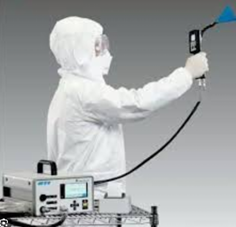
The filter leakage test (filter leak testing) is a critical technique in the validation and maintenance of clean roomsespecially in environments where air purity is essential, such as in the pharmaceutical industry, hospitals, biosafety laboratories and semiconductor manufacturing.