Event Report
E-Mobility (Digital Cycle II)

As one example among many studies conducted in the field [...]
As one example among many studies conducted in the field of e-mobility, the Bloomberg NEF 2020 Electric Vehicle Outlook notes that global annual demand for lithium-ion batteries will exceed 500 GWh by 2025 (passenger and commercial electric vehicles, electric buses, stationary storage, e-motors, and e-components), with an average annual growth rate exceeding 20% through 2030. The capacity of the major lithium-ion battery megafactories will reach more than 2,000 GW by 2028.
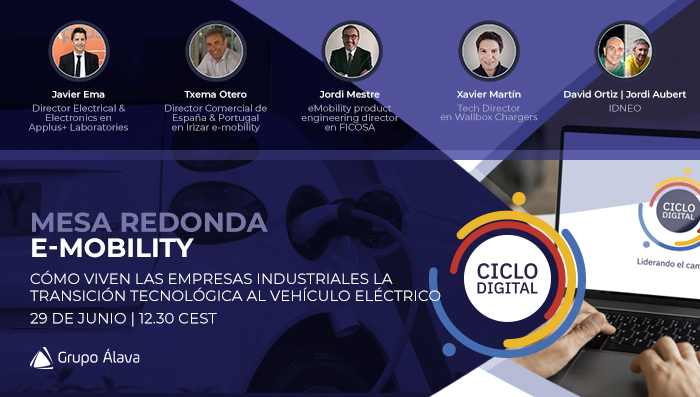
Industrial companies that operate directly or indirectly within this trend are adapting their capabilities, using it as a key element of competitiveness in their value propositions. In this roundtable discussion, we will be joined by five leading companies that are at the heart of the e-mobility equation on a national level:
- Javier Ema – Director of Electrical & Electronics at Applus+ Laboratories
- Txema Otero – Sales Director for Spain and Portugal at Irizar eMobility
- Jordi Mestre – Director of eMobility Product Engineering at FICOSA
- Xavier Martín – Tech Director at Wallbox Chargers
- Jordi Aubert – Director of Engineering at IDNEO
- Moderator: Juan Antonio Gil
Javier Ema: There are many companies that want to enter the electromobility sector; some need to incorporate technologies they don’t currently have, while others need to gain a better understanding of the sector. Technology centers—whether focused on a single technology or spanning multiple technologies and sectors—can provide insight into both the industry and the technology itself, with multidisciplinary teams that can help companies enter this field.
Jordi Aubert: For the first time in history, we view the car as a device that connects to the power grid; it becomes just another element of the grid—a connected element. We view connectivity as a practical necessity for electric cars. It doesn’t have to be that way, but in reality it is—and it’s very convenient that it is. Therefore, it also becomes another component of the Internet of Things.
Txema Otero: This entire pandemic situation has sparked a revolution in Europe’s strategy, and all those predefined emissions targets have been thrown out the window. Overnight, we’ve shifted to a strategy of decarbonization and digitalization.
Xavier Martín: How can we improve vehicle range and optimize the charging process? Our approach has been to improve this charging process and explore how we can revolutionize it. We’re creating bidirectional chargers that shift the paradigm slightly and turn the car into the energy hub of a home, capable of powering the residence. This revolutionizes the way we currently understand home energy management.
Jordi Mestre: The hub has been the icing on the cake, allowing us to bring together in one place the full range of capabilities needed to develop the products we’re responsible for. In this case, that includes two product families: high-voltage battery management and the charging of those same batteries.