
Description
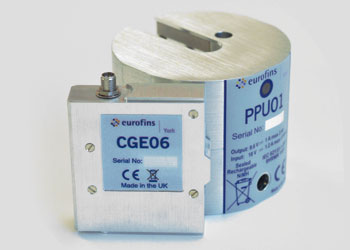
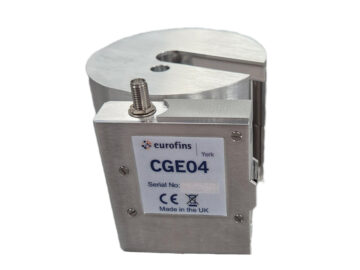
The CGE04 is a broadband comb generator emitter and reference source that upgrades and replaces the CGE01 model. Its main function is to perform testing and characterization in test environments such as fully or semi-anechoic chambers, generating a stable and repeatable output in the frequency range from 100 MHz to 18 GHz.
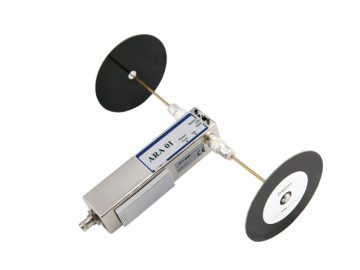
It is equipped with a precision SMA output connector that allows the attachment of an optional antenna to generate radiated electric fields. Its compact design and metal housing allow it to be mounted in direct contact with a ground plane. To minimize the effects of cables, it can be operated independently with a rechargeable battery (PPU01) or continuously via an external power adapter. The device offers two selectable comb modes, giving it great flexibility for a wide range of test and validation applications.
General Characteristics
-
100 MHz to 18 GHz output: Wide range of applications.
- Stable output and repeatable measurements.
- Selectable comb frequency: Flexibility for different applications.
- Compact and portable: Dimensions 56 x 17.5 x 72 mm.
- Dual power supply: Works with PPU01 battery to avoid cable effects or with external power adapter for continuous operation.
Technical Specifications
-
Frequency Range:
- Conducted: 100 MHz at 18 GHz (direct connection to 50 Ω system).
- Radiated: 1 GHz to 18 GHz (using the optional MCN02 antenna).
- Comb pitch size:
- Mode 1: 100 MHz base frequency (100 MHz, 200 MHz, … 18 GHz).
- Mode 2: 106.25 MHz base frequency (106.25 MHz, 212.5 MHz, … 17.95625 GHz).
- Amplitude stability: < +/-1.5 dB (from 100 MHz to 18 GHz).
- Frequency stability: < +/- 30 ppm maximum.
- Output Connector: Precision SMA jack, 50 Ω.
- Weight: 0.1 kg (CGE04 only); 0.65 kg (with PPU01 battery).
- Power supply: 9 – 18 VDC, 0.5 A max.
- Battery operating time: 7.5 hours typical with PPU01 fully charged.
- Indicators: blue LED (Mode 1), green LED (Mode 2) and red LED (low battery / power failure).
- Controls: 3-position switch (Mode 1 | OFF | Mode 2).
Applications
- Validation and verification of measurement systems (conducted and radiated).
- Characterization of anechoic and shielded chambers.
- Reference source for daily checks (standards such as ISO 17025, DEF_STAN 59-411).
- Comparisons between test sites and long-term performance monitoring.
- Measurement of cable losses.
- Component evaluation (filter loss, amplifier gain).
- Spectrum analyzer pre-checks.