
Description
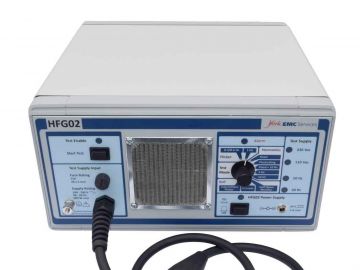
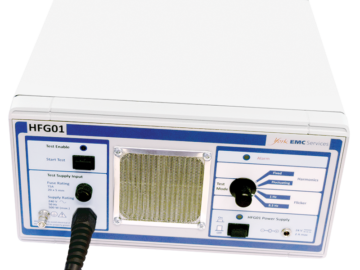
The HFG01 Harmonic and Flicker Generator has been specifically designed to verify harmonic and flicker test equipment. It provides a reliable method to externally check the performance of measurement systems against EN/IEC 61000-3-2 and EN/IEC 61000-3-3 standards. This is especially important as these tests rely on complex software and calculations, where there is no intuitive perception of the response.
The HFG01 is a stand-alone device that generates a series of harmonic and flicker disturbances of nominal but stable level, allowing the user to periodically check their test equipment to maintain compliance with regulations and laboratory quality procedures. It connects directly to the test equipment, simulating an “Equipment Under Test” (EUT) and generating known and repeatable disturbance levels. Due to its stability, it can also be used as a transfer standard from a known calibrated test system.
General Characteristics
-
Stable load simulation: Ensures repeatable measurements for system verification.
- Compliance with standards: Injects harmonics according to EN 61000-3-2 and flicker according to EN 61000-3-3-3.
- Harmonic test modes:
- Fixed: Harmonic-rich load current in steady state.
- Fluctuating: Harmonic-rich load current that fluctuates between two load conditions.
- Flicker test modes:
- Network disturbance at a rate of 1 Hz.
- Grid disturbance at a rate of 8.33 Hz.
- Compact and portable.
- Independent power supply: Prevents contamination of test signals.
Technical Specifications
-
Dimensions: 330 mm x 320 mm x 170 mm.
- Weight: 6.5 kg.
- Power supply: External, 24 Vdc, 1 A max.
- Test supply connector: 1.3 m captive cable with CEE7/7 plugs.
- Indicators: Thermal shutdown alarm.
- Harmonic current: Generates up to the 40th harmonic (from 50 Hz to 2 kHz).
- Flicker disturbance: 1 Hz and 8.33 Hz rates.
Applications
-
Validation and verification of harmonic and flicker measurement systems.
- Reference source for:
- Daily pre-test checks required by accreditation authorities (e.g. ISO 17025).
- Long-term performance monitoring.
- Comparison between different measurement systems or sites.