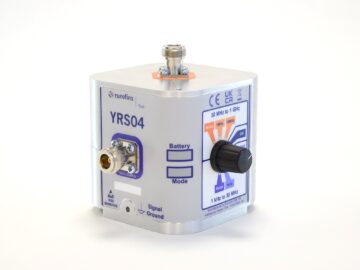

Description
The YRS04 is a noise and comb reference source that generates output signals in the frequency range from 1 kHz to 1 GHz. This versatile device combines two capabilities in one: it can produce both a broadband noise signal and a comb signal with selectable frequency steps.
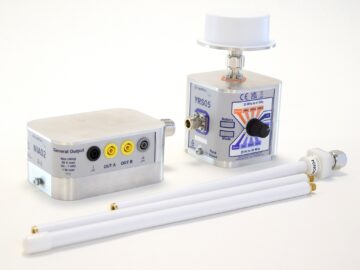
Designed to be an ideal reference tool for EMC laboratories, the YRS04 is battery powered to allow stand-alone operation without interference from power cables. It has two N-type output connectors for direct connection to conducted measurement systems (one for low frequency and one for high frequency). For radiated measurements, an optional configurable monopole antenna can be used, making the YRS04 a reference radiating source. Its flexibility makes it perfect for system validation, test environment characterization and inter-laboratory programs.
General Characteristics
-
Output from 1 kHz to 1 GHz: Broad spectrum applications.
- Dual functionality: Selectable noise or frequency comb output.
- Stable output: Reliable and repeatable measurements.
- Compact and portable design: Dimensions 85 x 85 x 85 mm, weight 0.8 kg.
- Battery powered: Operates on 4 AA batteries, eliminating the effects of power cords on measurements.
- Multiple comb modes: Five different comb modes with steps from 1 kHz to 10 MHz.
Technical Specifications
-
Frequency Range:
- Conducted: 1 kHz to 1 GHz.
- Radiated: 100 kHz at 1 GHz (with optional MON04 antenna).
- Amplitude stability: < +/- 1.5 dB (between 5°C and 40°C).
- Stability over time: < 1 dB (typical over a 12-month period).
- Noise Modes: Low frequency (LF) and high frequency (HF) modes.
- Comb modes (steps): 1 kHz, 10 kHz, 100 kHz, 1 MHz and 10 MHz.
- Output Connectors: 2 x N-type, 50 Ω (LF: 1 kHz – 30 MHz / HF: 30 MHz – 1 GHz).
- Power supply: 4 AA batteries (alkaline or rechargeable NiMH).
- Operating time: > 10 hours in comb mode; > 6-10 hours in noise modes.
- Controls: Rotary switch to select the operating mode.
Applications
-
Validation of conducted and radiated measurement systems.
- Characterization of anechoic chambers and open area test sites (OATS).
- Reference source for verification (ISO 17025), performance monitoring and inter-site comparison.
- Evaluation of components, cables and antennas.